

If you’ve ever tried to create a marketing strategy by throwing ideas at a whiteboard and hoping something stands out, you’re in good company.
However, there’s a smarter way, and it doesn’t involve guessing, panic-posting on social media, or consulting your friend who “took a marketing class once.”
We’re talking about the GSOT approach. The Goals, Objectives, Strategies, and Tactics marketing framework is simple, structured, and (dare we say?) pretty elegant.
GSOT turns big ideas into actionable steps. No more complicated marketing strategies that nobody can understand. It’s time to create a marketing strategy so simple that even your sales and leadership team can understand it.
Using the GSOT method will ensure your marketing budget isn’t wasted and that it delivers measurable results.
Interested in learning more? Let’s get into it.
Why Does Having a Marketing Strategy Matter?
A marketing strategy is what separates intentional growth from “we’re just doing stuff because someone on LinkedIn said we should.”
With a clear marketing strategy, you can:
- Align marketing efforts with big business goals
- Attract your target customers
- Spend your marketing budget with purpose
- Increase leads and drive actual growth
Simply put: a strategy gives you direction. The GSOT framework gives you that direction and a roadmap.
But… What Exactly Is a Marketing Strategy?
A marketing strategy outlines where you’re going and how you’ll get there. It connects your business goals to your marketing tactics in a structured, measurable way.
Your marketing strategy will likely include:
- The goals that support your long-term vision
- The strategic approach you’ll use in a competitive market
- Marketing objectives and KPIs
- Tactics that define how you’ll execute the strategy
- Supporting elements like:
– buyer personas
– market research
– competitive analysis
– content marketing plan
In other words, we want to create a winning strategy that isn’t random or reactive. Instead, it’s rooted in data-driven insights, analytics tools, and what your target audience actually wants to see.
If you’re in the B2B industry, now’s probably the time to jump on this bandwagon. Up to 76% of B2B companies have had a formal marketing plan since 2020, and that number is only going to keep rising.
What Is the GSOT Method and How Does It Work?
Okay, so about this acronym. GSOT stands for:
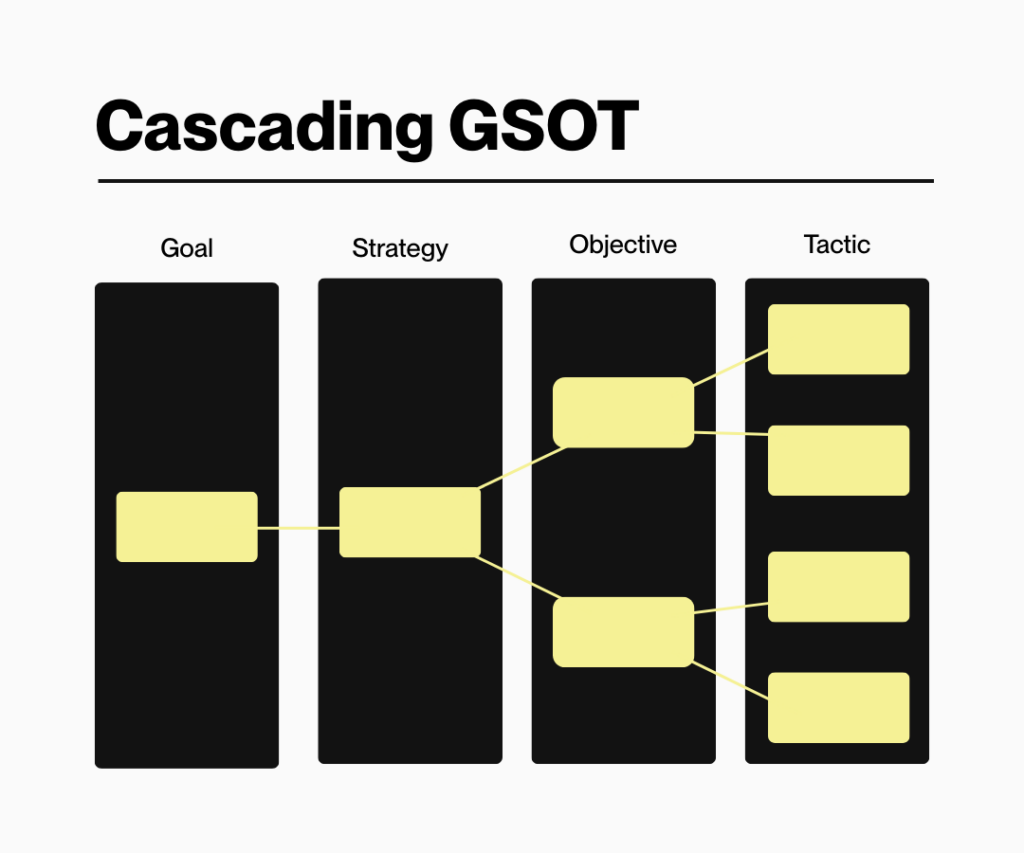
Goals → Strategies → Objectives → Tactics
It’s a cascading, top-down method that transforms a big idea into a measurable, trackable marketing plan.
Let’s break down each layer.
1) Goals
Goals are your high-level business aspirations. They connect marketing to business strategy and long-term vision. These are typically growth-oriented and connected to measurable initiatives in marketing and sales.
We break these goals into two main categories:
Growth
-
- Generate X marketing-qualified leads (MQLs) per month/quarter
- Increase conversion rates from inbound channels
- Increase sales for X service or product
Brand & Presence
-
- Improve brand visibility and reputation
- Outshine competitors through a stronger digital presence
- Enhance website performance, design, and UX
Goals define your destination, but not necessarily the route. This is simply where you want to end up.
2) Strategies
Next, your strategies are the broad approaches that describe HOW you’ll accomplish your goals.
Growth
-
- Content marketing & SEO to attract inbound leads
- Paid advertising campaigns (Google Ads, Meta Ads, LinkedIn Ads)
- Marketing automation and nurturing campaigns
Brand & Presence
-
- Website redesign or refresh for authority and credibility
- Social media brand building & thought leadership
- Enhance local SEO and reputation management
Your strategies reflect your unique value proposition, market opportunities, and how you’ll operate in a competitive market.
3) Objectives
Objectives give you something to measure against: your KPIs. They make your strategy real through specific performance targets. Be sure to follow the S.M.A.R.T. framework – specific, measurable, achievable, relevant, and time-bound.
Examples of measurable objectives (we’ll assume they’re all set to be achieved in a specific timeline):
-
- Increase qualified leads by 20%
- Boost landing page conversion rates by 10%
- Optimize content to rank in the AI summary
- Achieve 20% increase in organic website traffic in 6 months
- Achieve top 3 rankings for 5 high-value keywords in 12 months
- Gain 500 new social media followers per month with consistent engagement
Objectives are where Google Analytics, predictive analytics, performance analysis, and data-driven insights earn their keep. The more specific and measurable your goals are, the better.
4) Tactics
Tactics are the specific steps you take to bring your broader strategies to life. They’re the hands-on activities that keep momentum moving and turn intention into measurable progress.
Examples of specific marketing tactics:
-
- SEO & Content Marketing
- Publish 2–4 optimized blog posts per month
- Build backlinks from industry-relevant sites
- Optimize on-page SEO for target pages
- Paid Media
- Launch and A/B test new ad creatives monthly
- Build retargeting funnels for site visitors
- Optimize campaigns weekly to improve ROAS
- CRO & Website Improvements
- Run A/B tests on CTAs, headlines, and landing page layouts
- Improve page speed and mobile usability
- Add lead magnets (guides, calculators, free trials)
- Social Media & Branding
- Post 3–5 times per week across chosen platforms
- Engage daily with comments and community interactions
- Collaborate with industry influencers once per quarter
- Automation & Nurturing
- Implement email drip campaigns for new leads
- Score and segment leads by engagement behavior
- Set up monthly reporting dashboards for clients
- SEO & Content Marketing
Tactics can evolve quickly based on market conditions or what your data is telling you. Make data-driven decisions and remain flexible in your approach to creating tactics. Always attach them to a measurable objective.
We recommend reviewing and updating your objectives and tactics on a quarterly basis, while your goals and strategies will largely remain the same.
How Does GSOT Help You Track Progress Over Time?
One of the biggest strengths of the GSOT framework is that it makes progress visible. Each layer connects directly to the next; you always know what you’re measuring and why it matters.
Instead of guessing whether your marketing efforts are working, GSOT gives you…
✔ Clear KPIs
Each objective ties directly to measurable key performance indicators, making it easier to evaluate whether you’re moving in the right direction. Considering that up to 26% of marketers claim they don’t have enough data to make decisions, this can give you a serious leg up.
✔ A Structured Reporting System
The framework organizes your goals, strategies, objectives, and tactics in a way that naturally flows into consistent reporting (monthly, quarterly, or even weekly).
✔ Marketing Efforts That Drive Results
Because tactics map to objectives and objectives map to strategies, you gain instant visibility into which activities are delivering impact and which may need rethinking.
✔ Easy to Adjust
If market conditions shift or analytics tools reveal new trends, you can pivot your day-to-day tactics while keeping your overall strategy firmly on track. You’re more likely to correct your course if you can see where you’re going.
How Does Cascading Strategy Strengthen Your GSOT Plan?
Cascading strategy (popularized by the company Cascade) means every big-picture business goal breaks down into smaller, trackable steps.
GSOT mirrors this flow:
Business goals → Marketing strategy → Marketing objectives → Tactics
When everything cascades downward and aligns upward, you eliminate confusion, reduce overlap, and give every team a streamlined execution experience.
What Does a Real GSOT Strategy Look Like?
To see how the GSOT framework works in action, here’s a detailed example based on a recent engagement (anonymized but very real). Notice how each layer supports the next; this is the power of a cascading, structured strategy.
1) Goal
Expand brand presence in two new regional markets and increase qualified leads to 30/quarter.
This goal reflects a long-term vision: entering new markets, increasing visibility, and driving revenue growth. It sets the direction before any tactical conversations begin.
2) Strategy
Use a blend of digital marketing, content marketing, and community engagement to build brand authority, increase visibility in target regions, and strengthen the company’s competitive advantage.
This strategy answers how the brand will pursue expansion. It focuses on channels where the existing target audience is already active, while also preparing the company to identify opportunities in new segments.
3) Objectives
Each objective ties back to measurable KPIs that indicate whether the strategy is working.
- Increase total website sessions by 30% to drive top-of-funnel awareness in new and existing markets.
- Improve conversion rates on core landing pages by 15% to maximize the value of increased traffic.
- Grow qualified leads from target regions by 20% to support sales goals tied to market expansion.
- Increase content engagement by 25% as a proxy metric for customer preferences, topic relevance, and messaging strength.
These objectives connect directly to analytics tools, Google Analytics dashboards, and ongoing performance analysis throughout the year.
4) Tactics
This is where strategy becomes actionable. Each tactic supports an objective, so your team knows what to do and why.
Objective 1: Increase website sessions by 30%
- Market research: Regional pain points, trends, competitors
- Regional SEO pages: Match local search intent
- Geo-targeted ads: Drive traffic in priority regions
Objective 2: Improve landing page conversion rates by 15%
- Regional personas: Buying triggers and objections
- Stronger proof: Case studies and customer stories
- Page testing: Headlines, CTAs, layouts
Objective 3: Grow qualified leads from target regions by 20%
- Region-specific campaigns: Ads and offers by market
- Segmented nurture: Follow-up by region and interest
- Lead capture improvements: Forms, CTAs, lead magnets
Objective 4: Increase content engagement by 25%
- Regional content calendar: Topics tied to local priorities
- Social proof content: Testimonials, UGC, mini case studies
- AI insights: Content gaps and top themes from performance data
These tactics aren’t static; they evolve as market dynamics shift, as analytics reveal patterns, and as customer preferences sharpen.
Why This Example Works
This example illustrates the entire GSOT cascade. When each layer supports the next, you end up with a marketing plan that’s adaptable, data-driven, and genuinely useful for guiding day-to-day decisions.
Let’s Jumpstart Your 2026 GSOT Marketing Strategy
You’re setting big goals for 2026. Now, you need a structure that can actually support them.
At Lasso Up, we don’t hand you a generic playbook or a buzzword-filled “strategy deck.” Instead, we help you build a digital marketing strategy that’s grounded in reality, aligned with your business goals, and organized so your team always knows exactly what to do next.
Let’s build next year’s marketing strategy together—partner with Lasso Up for a GSOT-driven plan that’s based on your goals.