

If every agency pitch you hear sounds like a remix of “SEO + ads + social = growth,” you’re not crazy.
Most businesses don’t fail to grow because they chose the wrong marketing channel. They fail to grow because they chose the wrong structure.
Real marketing growth comes from operating your marketing like a system. Each new asset or campaign should build on the next. It should compound over time, rather than resetting every quarter.
Let’s break down how to choose a growth marketing program that actually helps your business grow, and how to spot the ones that don’t.
Program vs. Tactics: Why Structure Beats Channels Every Time
Here’s the core buyer mistake: hiring agencies based on the services they offer rather than the systems they build.
SEO is not a strategy. Ads are not a strategy. Social is not a strategy. They’re tactics for your overarching strategy. They’re key ingredients for your recipe.
Without a tried-and-true recipe, you just have a very expensive mess.
One-off campaigns fail because they don’t talk to each other. There’s no shared growth strategy, no momentum, and no learning loop. You get activity, but not progress.
That’s the difference between:
- Activity-based marketing: publishing, posting, launching, reporting.
- Operational growth systems: diagnosing, prescribing, executing, learning, optimizing,
Traditional marketing tends to optimize channels in isolation. Growth marketing programs focus on how those channels work together across the entire customer journey, from first click to closed deal to repeat revenue.
When marketing is treated as a unified operating system, something magical happens: compounding. Each cycle improves the next. That’s the snowball effect.
At Lasso Up, this is where our team draws a hard line. We operate as a marketing system owner because we know execution only works once a structure is in place.
The Foundation Test: Does the Program Fix What’s Broken First?
The most honest question a buyer can ask is: “Why didn’t my last marketing agency work?”
Usually, the answer lies in the foundation. Common failure points show up as:
- A dated brand trying to compete in a modern market
- Unclear positioning that confuses prospects
- Websites that look good but don’t convert
- Messaging that contradicts itself across digital marketing channels
- Lack of consistent execution
A classic example: a company trying to sell itself as a custom home builder while calling itself a general contractor everywhere online. No amount of search engine optimization or paid search fixes that disconnect.
When your website says ‘general contractor’, but you want to be a ‘custom home builder’, we have a serious problem. But there’s an easy solution.
Scaling before fixing the foundation multiplies the waste. Strong programs are willing to slow down before they speed up. They invest early in clarity so every dollar spent later works harder.
At our marketing company, our build phase is a decision gate. Growth doesn’t proceed until positioning, messaging, and alignment are locked, just like you wouldn’t pour concrete before approving architectural plans.
Growth Rhythm: How Often Strategy Evolves (and Why It Matters)
Another common misconception: once the new website is launched, new leads will come flooding in.
This couldn’t be further from the truth. This ‘set it and forget it’ mindset kills growth.
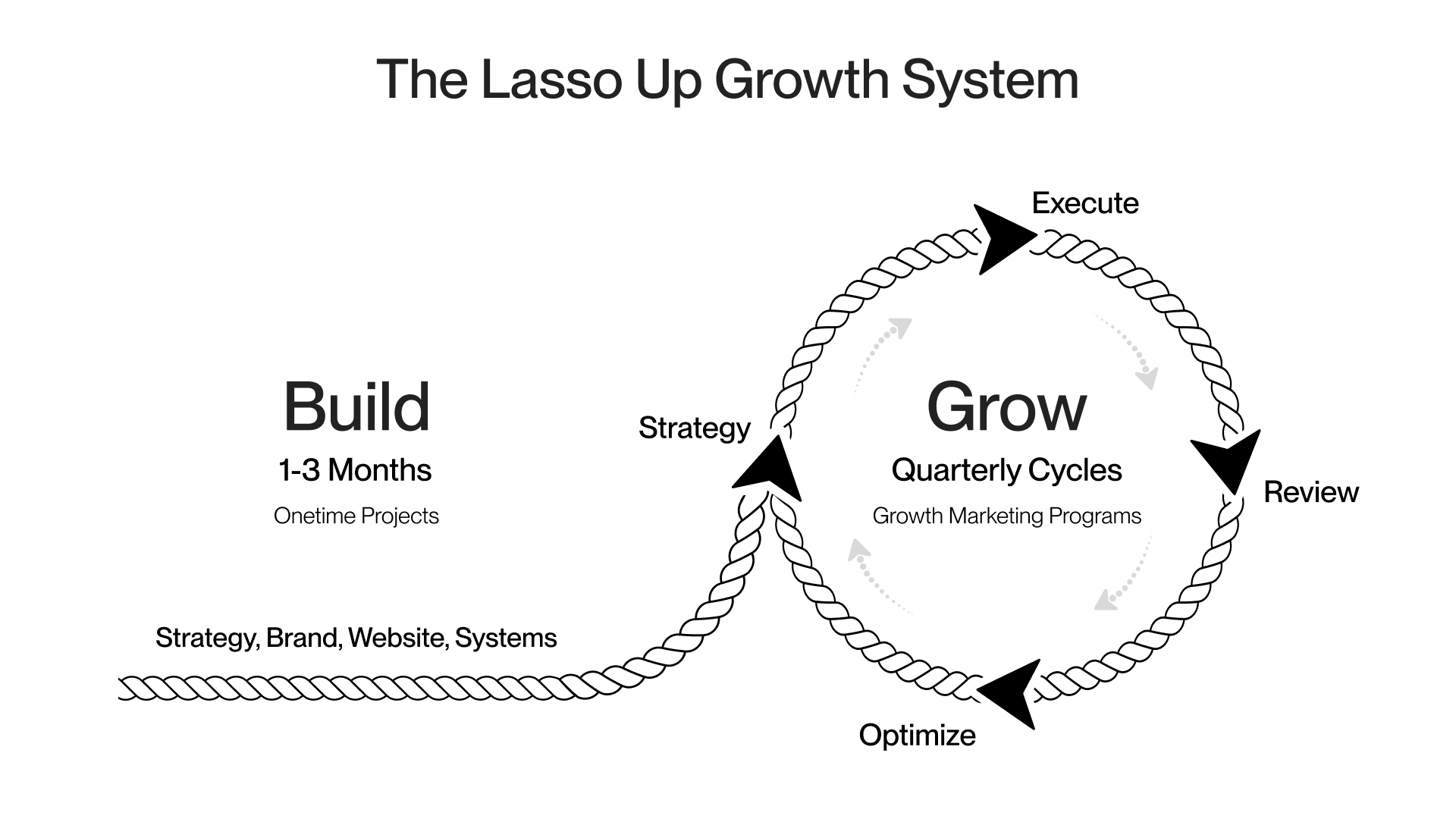
High-performing growth marketers don’t run on monthly busywork cycles. They operate in quarterly growth rhythms that allow time to test, learn, and adapt.
Here’s why it matters:
- Quarterly cycles create room for real optimization loops
- Strategy reviews lead to informed adjustments, not knee-jerk reactions
- Performance improves through iteration, not noise
There’s also a big difference between reporting and decision-making.
Reporting says: “Ad clicks are down 20%.”
Marketing decisions say: “Clicks dropped 20%. Based on audience fatigue and message mismatch, we recommend X, Y, and Z to restore performance.”
Metrics alone don’t grow companies. Strategic marketing decisions do.
At Lasso Up, our Quarterly Growth Rhythm is designed to turn data and customer insights into action. This creates predictability in lead flow and confidence at the leadership level.
Metrics That Matter to Leadership (Not Just Growth Marketers)
If a report looks impressive but doesn’t change a decision, it’s merely a decoration.
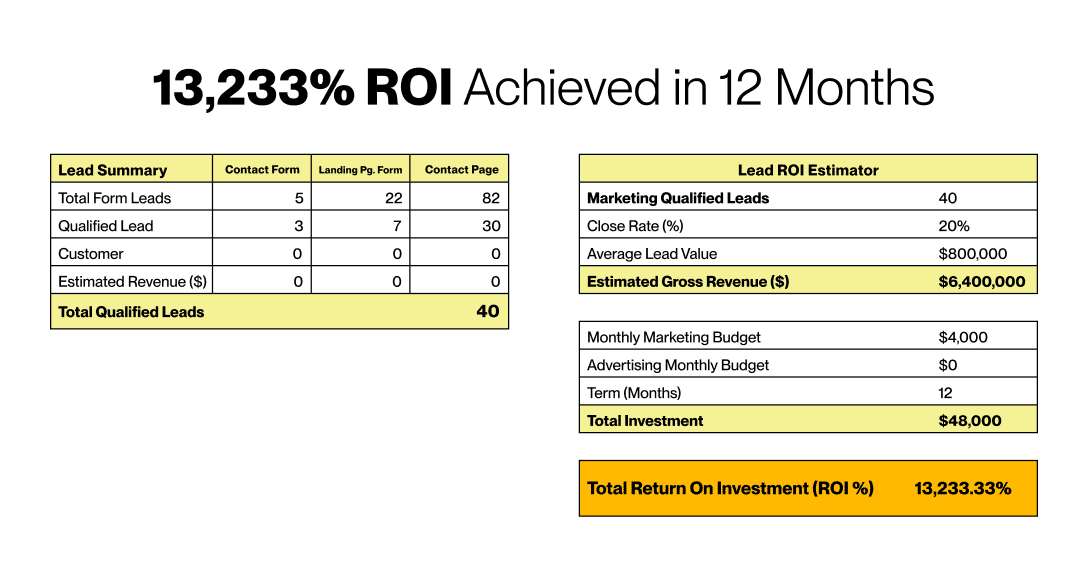
Leadership doesn’t care about vanity metrics. In fact, up to 83% of marketing leaders report prioritizing ROI demonstration over metrics such as pageviews.
They care about:
- ROI (return on investment)
- ROAS (return on ad spend)
- Lead quality
- Conversion rates
- Customer acquisition cost
The problem? Only about 36% of marketers can accurately measure ROI from their efforts.
Clicks without context are meaningless. What matters is how marketing efforts support sales, customer retention, and long-term value.
That requires a unified system that connects key performance indicators, CRM data, and attribution across channels. Customer relationship management tools only work when they’re integrated into the strategy.
Stop guessing. Instead, track the money. Follow it from first touch to closed deal.
For instance, our signal-based optimization approach starts with lead generation and conversion, then works backward through the data to optimize campaigns and improve lead quality.
Fit & Readiness: Not Every Business Should Be in a Growth Program
This part surprises people: Not every business is ready for a growth program. Some don’t need one.
A one-time brand or website build can make more sense when:
- Lead volume is healthy, but conversion is weak
- Growth is capped by operational constraints, not demand
- The business isn’t trying to scale, but the brand no longer reflects reality
- You have a strong marketing team, but want new strategic perspective
In those cases, new perspective and clarity may matter more than ongoing execution.
Long-term growth requires commitment more than urgency, and definitely more than quick fixes.
If these circumstances apply, a one-time project is recommended. When things change and growth becomes a priority, it’s time to consider the growth marketing program.
The Final Checklist: How to Choose the Right Program (Regardless of Provider)
Before signing anything, ask yourself:
- Does the program start with clarity instead of channels?
- Is there a documented execution rhythm?
- Are metrics tied to revenue decisions?
- Is optimization built into the operating model?
- Does the provider protect results through focus and capacity?
If the answer to any of those is “no,” you’re buying tactics more than growth. If those questions quietly point you toward a system-first approach… Well, you already know where to look.
Let’s Be Clear Before We Talk Business Growth Strategy
If you’re looking for someone to “run ads” or “do SEO,” we’re probably not your team.
On the other hand, if you want to know why your last efforts didn’t stick, where momentum keeps breaking down, and what would actually make a difference, we’re exactly who you should talk to.
At Lasso Up, we step in as system operators. We diagnose before we prescribe, and we recommend growth only when the structure can support it.
If you’re committed to growing your business and want a true partner focused on building compounding systems, not just executing tactics, you’re in the right place.
Ready to see what a growth marketing program looks like in action? Explore our Growth Marketing programs and see how we help businesses build sustainable, measurable growth.